Cobot Palletisers
Palletising that fits at the end of the line, in the space you already have.
Palletising in tight spaces
Fence-free, mobile, running the day it arrives.
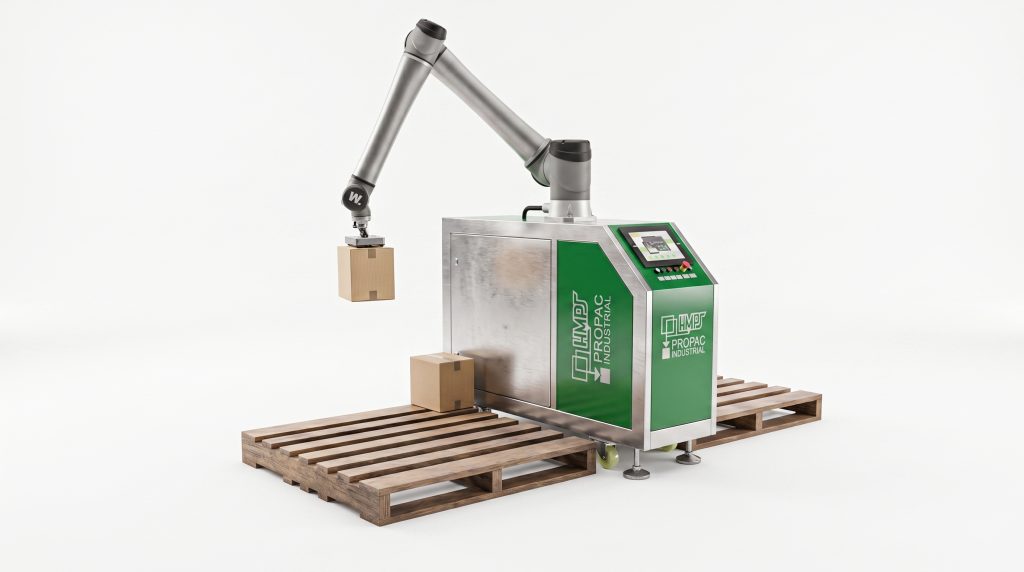
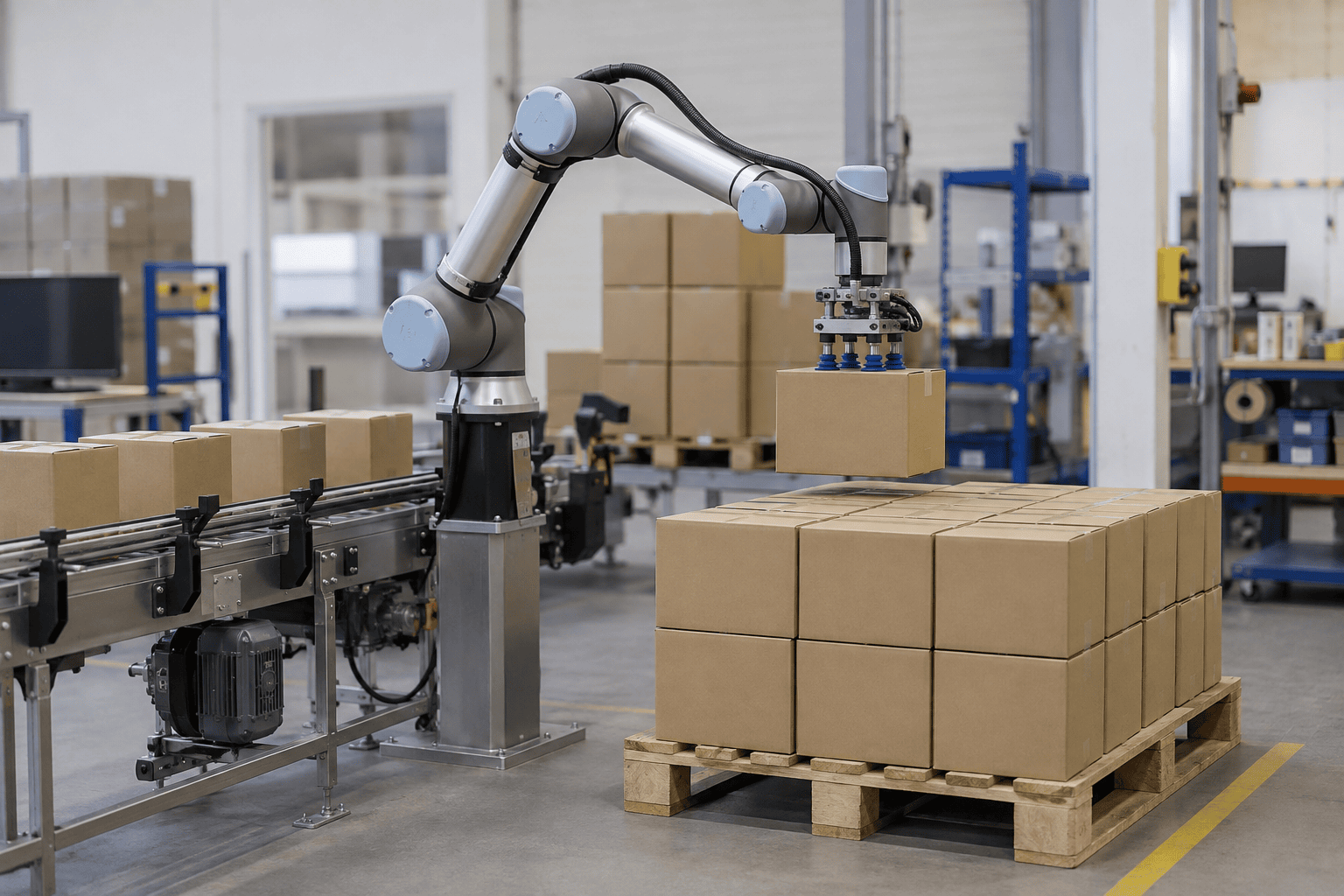
A cobot palletiser uses a collaborative robot — one with built-in force and speed limiting — to build pallets without perimeter fencing.
That makes it the answer where floor space or ceiling height rules out a guarded cell, and where the volume doesn’t justify a full robot cell.
The platform we build around carries a 25 kg payload including tooling and a 1,902 mm reach, which is what allows it to cover a standard Australian pallet rather than the smaller footprints most cobot palletisers are designed for.
Cells can be fixed or mobile: a mobile plinth on castors docks to mechanical datum stations at the end of each line, each with its own safety zone, so one capital purchase can de-man several lines.
-
Reaches a full 1,165 mm Australian pallet to 1,400 mm high — historically the limitation of cobot palletising, and the reason this platform exists
-
Fence-free operation subject to an application-specific risk assessment, in a footprint a guarded cell can’t fit
-
Mobile cells dock to fixed datum stations at the end of each line, so one machine can serve several lines
-
On site, connected and running in as little as one business day
-
Up to 4–6 cycles per minute collaborative, and higher with floor safety scanning
APPLICATIONS
-
Shipper & RSC cases
- Shipper cartons & RSC cases
- Cases from case packers
- Manual pack stations
-
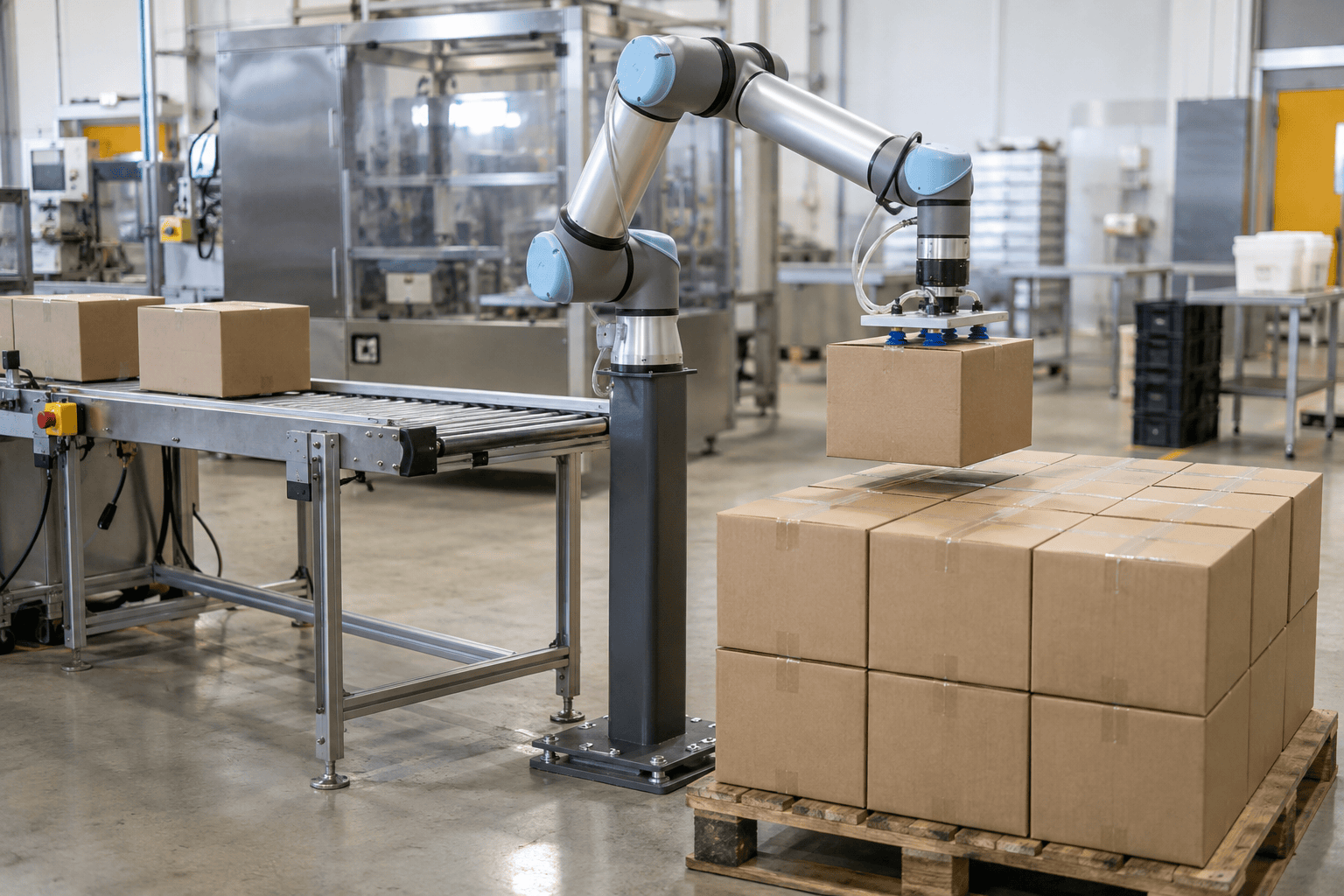
Inner & shelf-ready cartons
- Inner cartons
- Shelf-ready cartons
- Full 1,165 mm pallet to 1,400 mm high
-
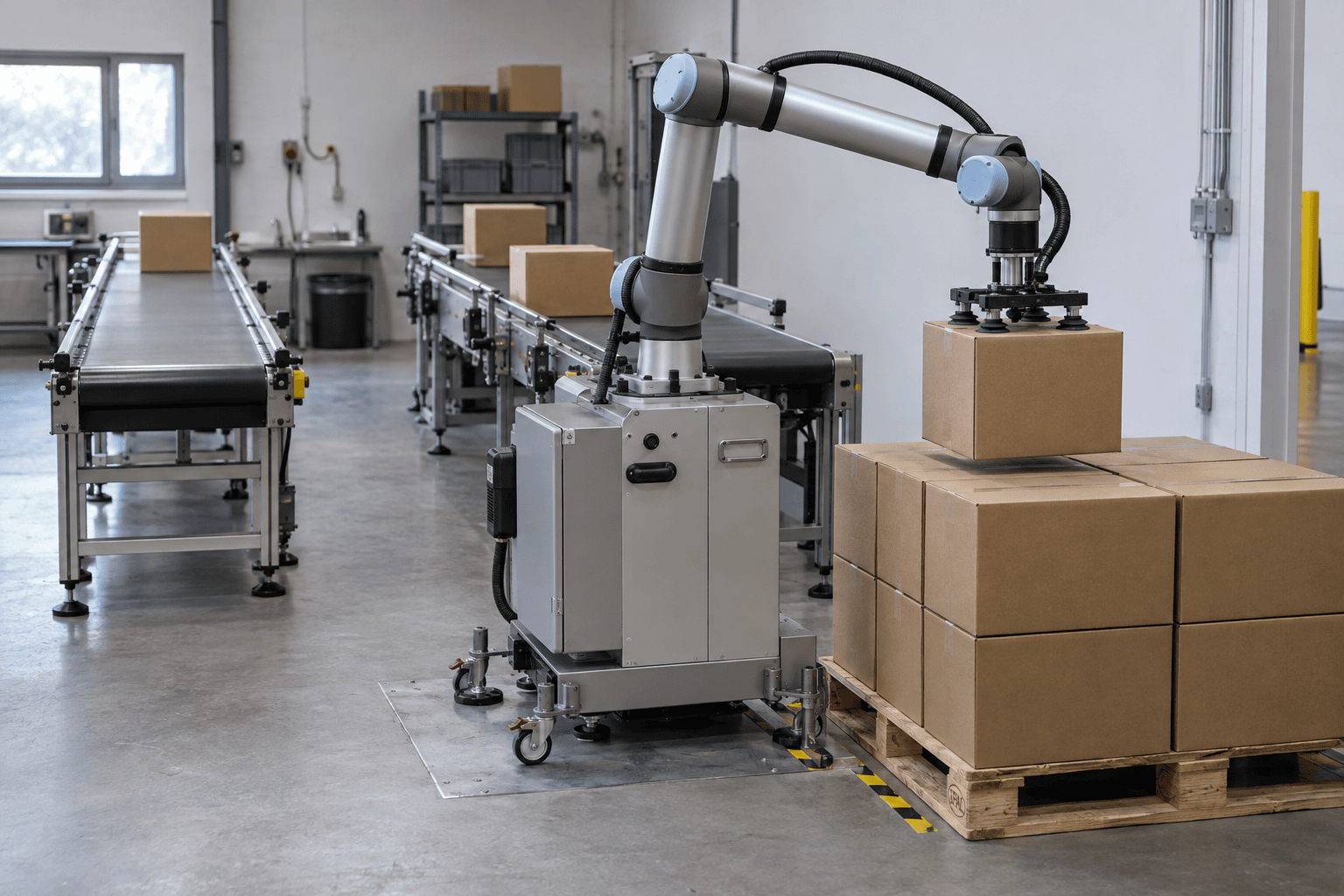
Mobile multi-line palletising
- Multiple slow lines served in rotation
- One mobile cell, several datum stations
- Lines that can't justify a fenced cell
-
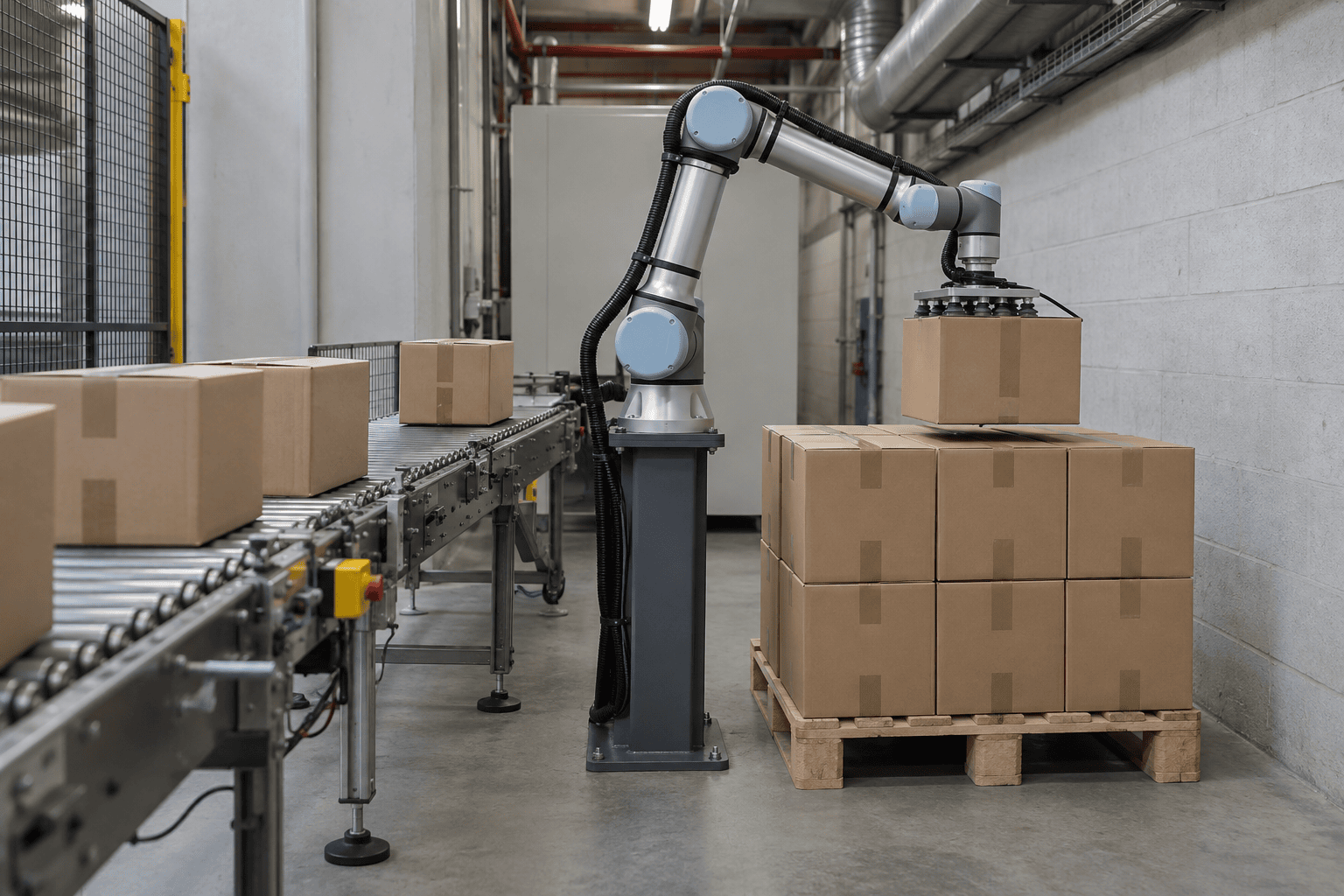
Tight-space installations
- Height-restricted sites
- Constrained end-of-line footprint
- Fence-free, subject to risk assessment
What makes our solutions different
-

Award-winning expertise
-

Robust engineering
-

On-site & 24/7 remote support
-

Australian made
KEY STATS
| Specification | Standard |
|---|---|
| Typical output | Up to 4–6 cycles/min in collaborative mode; up to 8 cycles/min with floor safety scanners |
| Payload / reach | 25 kg including tooling · 1,902 mm reach · ±0.05 mm repeatability · 6 rotating joints |
| Pallet | Standard 1,165 mm Australian pallet, single or dual stations, up to 1,400 mm finished height with the pallet on the floor |
| Picks | One carton per pick; carton weights up to 15 kg documented |
| Carton presentation | Base down, short end leading, datumed by adjustable side guide and fixed end stop |
| Cell contents | Cobot, vacuum gripper, plinth on castors with lowerable feet, two pallet locations with sensors, PLC and HMI, floor safety scanners, pallet-build software, driven roller conveyor, docking stations |
| Not included | Slip sheets and layer sheets, carton open-flap detection, pallet pattern design beyond the one proved at FAT |
| Robot environment | IP54, 0–50°C, ≤85% RH non-condensing |
| Controls | PLC and HMI in cabinet; robot comms via Ethernet, Modbus TCP/RTU, with PROFINET and EtherNet/IP optional |
| Power / air | 415V AC 3-phase 50Hz, 20A per system (robot 110–240 VAC, typically 500 W) · 6 bar, 350 L/min |
| Safety & standards | Category 3 minimum, Category 4 compressed air · AS4024 · AS3000 · HMPS risk assessment · 250 mm/s collaborative speed limit, 150 N external force limit |
| Install / lead time | Running in as little as 1 business day on site · 18–20 weeks from order |
FAQ
What is a cobot palletiser?
A cobot palletiser uses a collaborative robot — one with built-in force and speed limiting — to build pallets without perimeter fencing. It suits lower-throughput lines and constrained floor space, and can be made mobile to serve several production lines from one machine.
Can a cobot palletise onto a full Australian pallet?
Yes, and this has historically been the limitation of cobot palletising. A 1,902 mm reach on a fixed plinth covers a standard 1,165 mm Australian pallet to a height of 1,400 mm with the pallet on the floor.
How fast is a cobot palletiser?
In true collaborative mode, linear speed is limited to 250 mm/s, giving up to 4–6 cycles per minute. With floor safety scanners fitted the robot can run faster when the zone is clear, reaching up to 8 cycles per minute. The robot’s mechanical maximum is not achievable collaboratively.
Does a cobot palletiser really need no guarding?
It operates without perimeter guards subject to an application-specific risk assessment, which sets the external force limit and the collaborative speed limit. Where a higher rate is needed, floor laser scanners provide speed and separation monitoring in place of fencing. Fence-free, yes; unconditionally guard-free, no.
How heavy a carton can it handle?
The payload is 25 kg including the tooling, so practical carton weight is lower — we’ve delivered cells handling cartons up to 15 kg. Above that, a full robot cell with a clamp gripper is the better platform.
Can one cobot palletiser serve several lines?
Yes, and it’s the strongest application. A mobile cell on a castored plinth docks to fixed mechanical datum stations at the end of each line, each with its own safety zone. One machine can be scoped to serve several lines that couldn’t individually justify a palletiser.
How long does installation take?
One day. A cobot palletiser can be brought to site, connected and running in as little as one business day. Lead time from order is 18–20 weeks, largely driven by robot availability.
Can it apply slip sheets or handle empty pallets?
No — those sit outside the cobot cell scope. If you need slip sheets, layer pads or robot pallet handling, a full robot cell with a combination gripper is the right machine, and we’ll price one alongside.
How many cartons does it pick at once?
One. A full robot cell with a servo clamp gripper picks several cartons per cycle, and that difference accounts for much of the throughput gap between the two platforms.
When should I buy a full robot cell instead?
Above roughly 8 cycles per minute, when you need multiple cartons per pick, when you need slip sheets or pallet handling on the tool, when pallets exceed 1,400 mm, when you’re palletising heavy bags, or when one robot must serve several infeeds and pallet stations.