Robotic Palletising Cells
Your pallet is built to pattern, layer after layer, shift after shift.
Palletising your product
Heavy work, handled — around the clock.
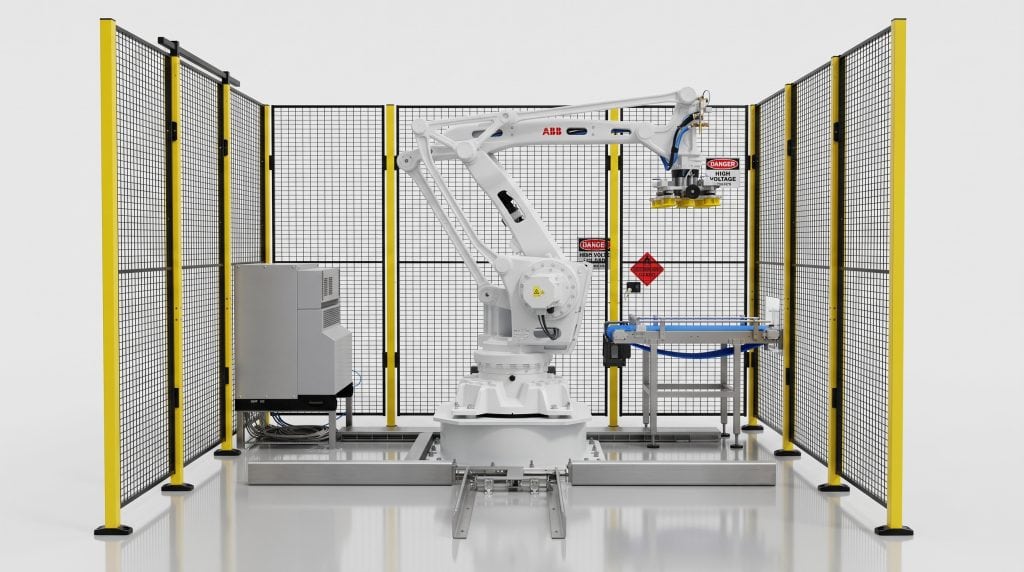
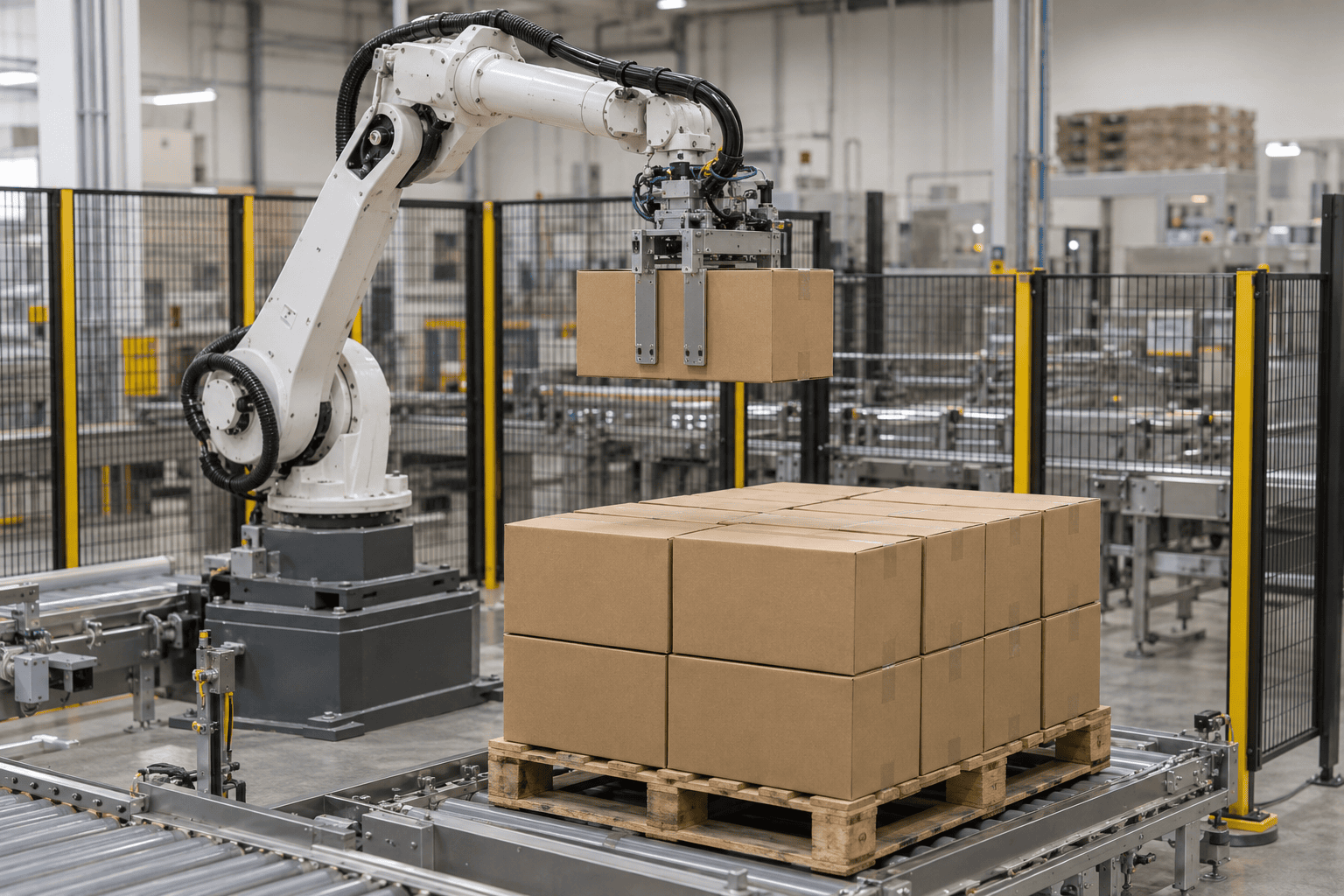
A robotic palletising cell uses an industrial robot to build pallets from cartons, bags, crates, trays, pails or drums arriving on conveyor.
We design and build the whole cell in Australia — robot, tooling, infeed, pallet handling, guarding and controls — which is where these projects are actually won or lost.
End-of-arm tooling is chosen against your product rather than the other way round: a servo clamp for cartons, vacuum for single-box and full-layer picks, a fingered gripper for bags, or a combination head that does several jobs without a tool change.
Cells run single or twin infeed, feed multiple pallet stations, and integrate directly with our own case packers and stretch wrappers on one control platform.
-
ABB-based cells built in Australia, running up to 22 cases per minute or up to 25 pallets per hour with automatic pallet handling
-
Our servo clamp gripper takes several cartons per cycle with no vacuum cups to wear out — the right answer for shelf-ready and heavily perforated board
-
Combination tooling gives clamp, retractable vacuum for slip sheets and retractable pallet hooks on one head, with no tool change
-
Handles multiple pallet sizes simultaneously, including Australian, ISO and Euro, each with its own dispenser
-
Pallet patterns are recipe data you build from the HMI, not code you have to call us about
APPLICATIONS
-
Cartons & cases
- Shipper cartons · RSC cases
- Shelf-ready & perforated board
- Meat cartons · pharmaceutical shippers
-
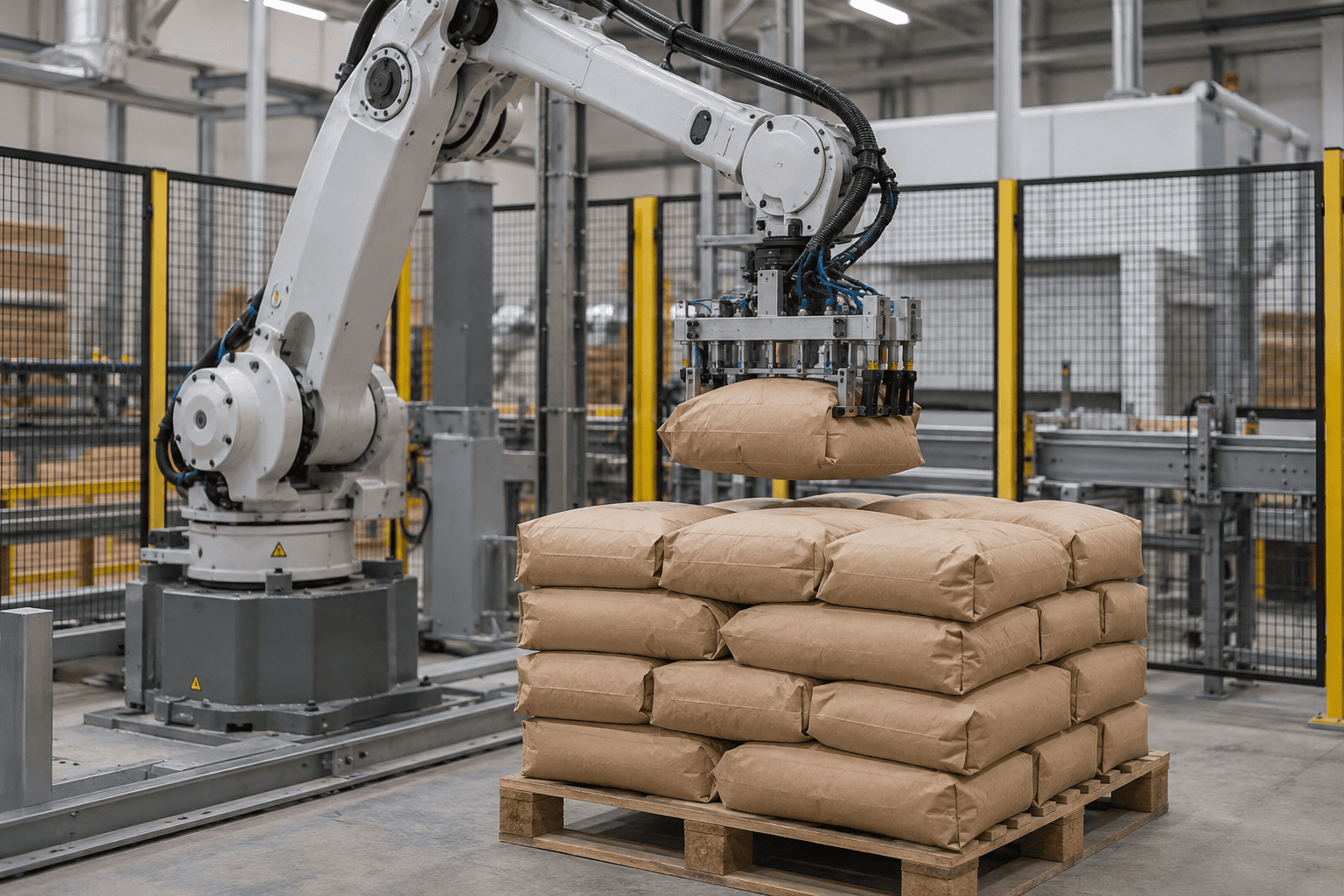
Bags & sacks
- Paper, plastic & mesh bags
- Sugar · flour · powder · salt
- Animal feed · minerals
-
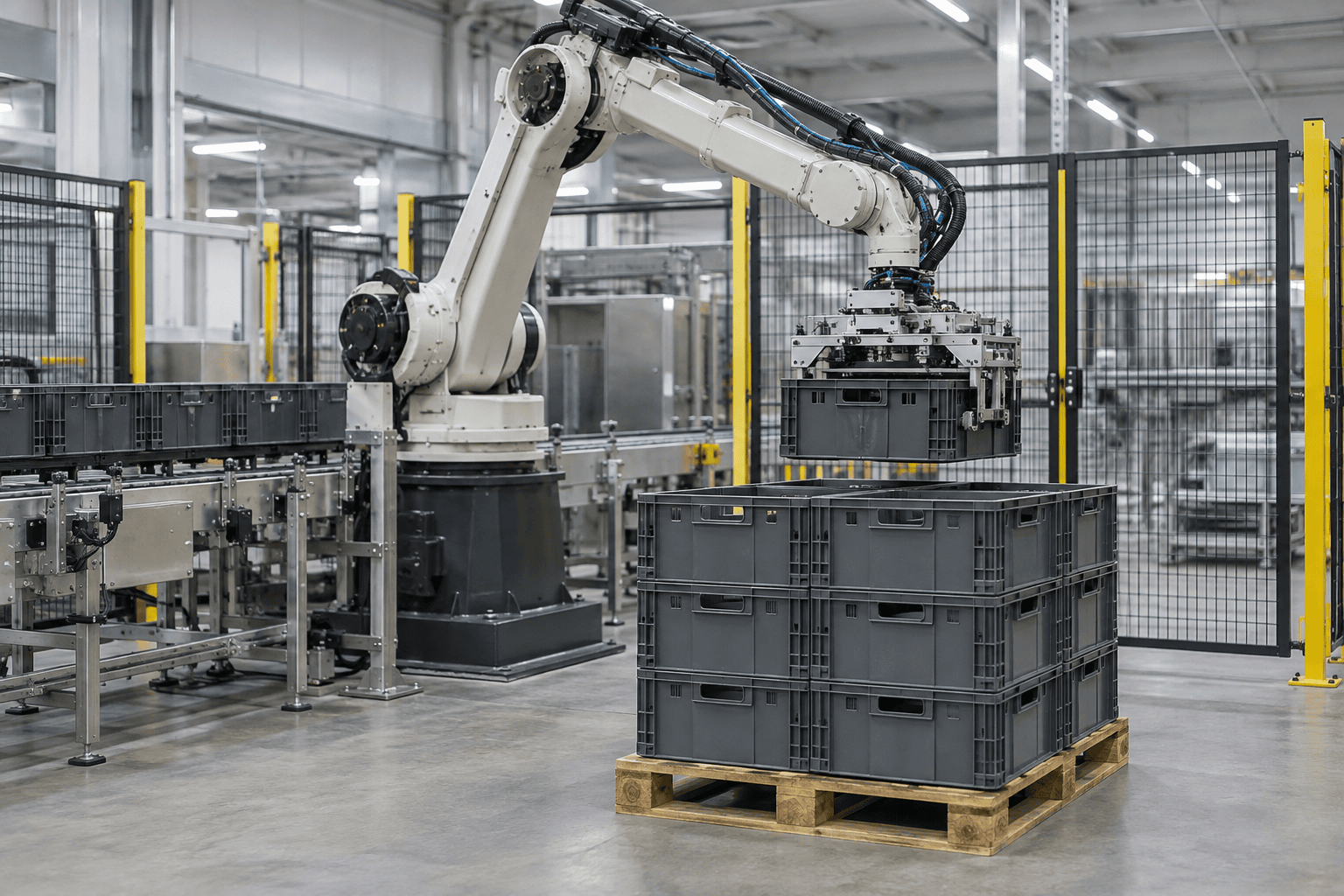
Crates & trays
- Crates & RPCs
- Trays & bright-stacked product
- Bottles, cans & jars, including de-palletising
-
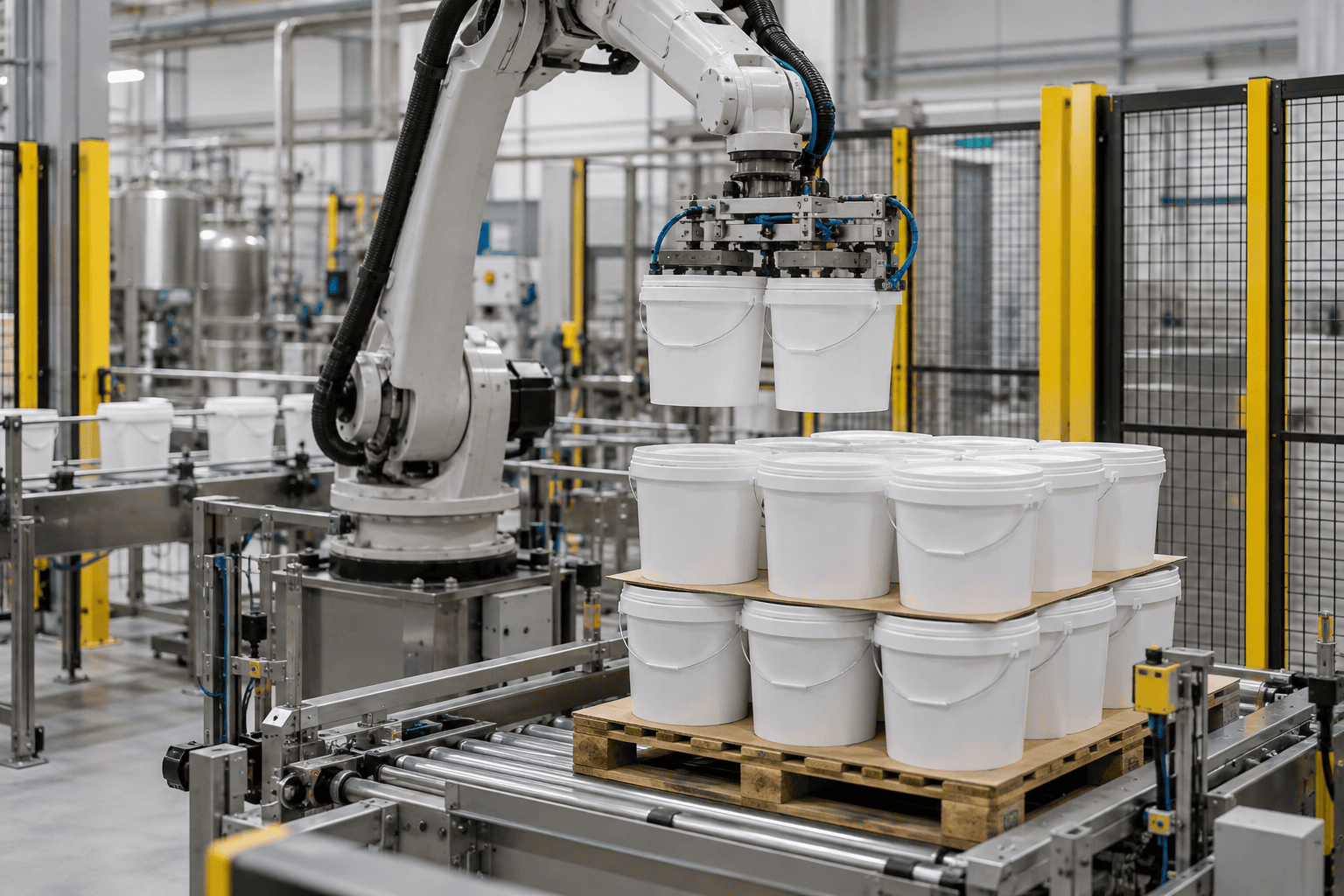
Pails & bulk containers
- Pails & tubs with layer sheets
- Drums · EPS mouldings
- Bag-in-box & wine casks
What makes our solutions different
-

Award-winning expertise
-

Robust engineering
-

On-site & 24/7 remote support
-

Australian made
KEY STATS
| Specification | Standard |
|---|---|
| Typical output | Up to 22 cases/min per cell, or up to 25 pallets/hour with automatic pallet handling; up to 20 bags/min with a double gripper |
| Robots | ABB IRB 460 (2.4 m, 110 kg), IRB 660 (3.15 m, 180/250 kg), IRB 760 (3.18 m, 450 kg), IRB 260 (1.5 m, 30 kg); arctic-spec robots for freezer rooms; built to your site robot standard |
| Tooling | Servo clamp gripper, vacuum single-box and full-layer grippers, bag grippers (185–500 mm width, 40–140 mm thickness), combination heads with retractable vacuum and pallet hooks |
| Pallet handling | Floor pallets at two load stations, robot-managed magazine with pallet hooks, or automatic dispenser holding 10–30 pallets, refillable without stopping |
| Pallet sizes | Australian/CHEP 1,165 × 1,165 default; ISO, Euro and export sizes, including several types in parallel |
| Infeed | Single, twin, or multi-lane merged infeed with per-carton sensing and routing; the IRB 660 services up to four infeeds |
| Patterns | Recipe data selectable from the HMI, with test-pattern and dry-run modes; new patterns built on site |
| Also available | Slip sheets, layer pads, plastic top sheets, pallet conveyors, accumulation, two-sided labelling with SKU verification, remote monitoring with in-cell camera |
| Controls | Allen Bradley CompactLogix, PanelView Plus, PowerFlex 525, SEW Eurodrive, AB servos, IFM sensors; robot controller ABB IRC5 or OmniCore |
| Power / air | 415V AC 3-phase 50Hz + N + E, 20A per system and 30A for robots · 6 bar, 350 L/min clean dry air |
| Safety & standards | Category 3 minimum, Category 4 compressed air · AS4024 guarding · AS4024.3404 palletiser safety · AS3000 wiring · interlocked trapped-key doors, light curtains at pallet exit and entry points |
LATEST ROBOTIC PALLETISING
FAQ
How fast is a robotic palletiser?
A single cell typically runs up to 22 cases per minute, or up to 25 pallets per hour with automatic pallet handling. Bag duties reach up to 20 bags per minute with a double gripper. Multi-cell systems scale well beyond that from the same design language.
Which robots does HMPS use?
ABB primarily — the IRB 460 for high-speed carton and bag work, the IRB 660 for long reach and multi-station cells, and the IRB 760 for full-layer duties. We use arctic-specification robots for freezer rooms, and we’ll build to your site’s robot standard.
Can one robot palletise from two production lines?
Yes. Twin-infeed cells where a single robot palletises from two carton feeds are a standard configuration, and a long-reach robot can service up to four infeeds, two pallet stacks, a slip-sheet stack and four outfeeds.
What pallet sizes can it handle?
Australian/CHEP 1,165 × 1,165 is the default. We build cells handling Australian, ISO 1,200 × 1,000 and Euro 1,200 × 800 simultaneously, and cells running three pallet types in parallel with a dispenser and conveyor for each. Export sizes are also built.
Clamp gripper or vacuum gripper?
Clamp for cartons, especially shelf-ready and heavily perforated board — no cups to wear out, no consumables, and far less risk of dropping a carton. Vacuum for single-box picks, full-layer picks and slip sheets. Combination heads give you clamp, vacuum and pallet hooks on one tool.
Can it handle empty pallets and slip sheets?
Yes, three ways: retractable pallet hooks on the gripper working from a magazine, an automatic pneumatic dispenser holding 10 to 30 pallets and refillable without stopping, or pallets placed on the floor at two load stations. Slip sheets are picked by retractable vacuum from a magazine.
Can it palletise 25 kg bags?
Yes. Bag duties run up to 20 bags per minute using a double gripper that picks two bags per cycle. Bag grippers adjust from 185 to 500 mm bag width by hand wheel in under 30 seconds, with ultrasonic bag-presence sensing.
Can it de-palletise as well?
Yes. We build de-palletising cells for cartons, crates, bottles, cans and bags, including bespoke bag de-palletisers with head-mounted 3D vision that pick, pierce, cut, empty, shake and strip the bag in one cycle.
How do I add a new pallet pattern later?
From the HMI. Patterns are recipe data, not code. We program and prove one pattern at Factory Acceptance Test and you build the rest on site — it’s designed to be done in house. If you’d rather we programmed all of them, we’ll scope it.
Will it integrate with a stretch wrapper?
Yes, and it’s a standard configuration. We manufacture our own stretch wrappers, so palletiser and wrapper come from one supplier on one control platform, with interfaced E-stops and a single point of support.